

Forward-looking asset management includes estate planning. If assets are inherited on death or given away during the donor’s lifetime, inheritance or gift taxes are incurred. It is possible to reduce the tax burden by making a gift during your lifetime, with a usufruct.

Inherited wealth in Switzerland has risen steadily over the past 20 years. In 2020, 95 billion Swiss francs were inherited in this country. If «a brother» in the city of Bern were to inherit this wealth, over 14 billion Swiss francs would be subject to inheritance tax. Of course, the online tax calculation is hypothetical, but it provides a reasonable estimate. If nothing else, it shows that inheritance tax is an aspect of estate planning that should not be neglected.
A gift – with/without usufruct
Estate planning is not necessarily the same as inheritance. Estate planning can also include a lifetime gift – or a lifetime gift with a usufruct.
What is a usufruct? Simply described, a usufruct (Art. 745 ff. ZGB) is a right that can be created on movable property, on real estate, on rights or on an estate. However, the recipient of the usufruct («usufructuary») is not the owner of the property.
The usufructuary may use the property and keep the income from it – but may not diminish the property. In the case of real estate, for example, the usufructuary may occupy the property subject to the usufruct or rent it out. The rental income belongs to the usufructuary, but he may neither sell nor give away the house nor convert it nor encumber it with mortgages.
The owner of the property can only dispose of it freely (again) after the death of the usufructuary, as the property is encumbered with a life-long usufruct. By law, the usufruct lasts for a maximum of 100 years.
From a tax point of view, no inheritance tax is payable on a lifetime gift whether or not the gift is subject to a usufruct, but gift tax is payable.
Significant tax advantage
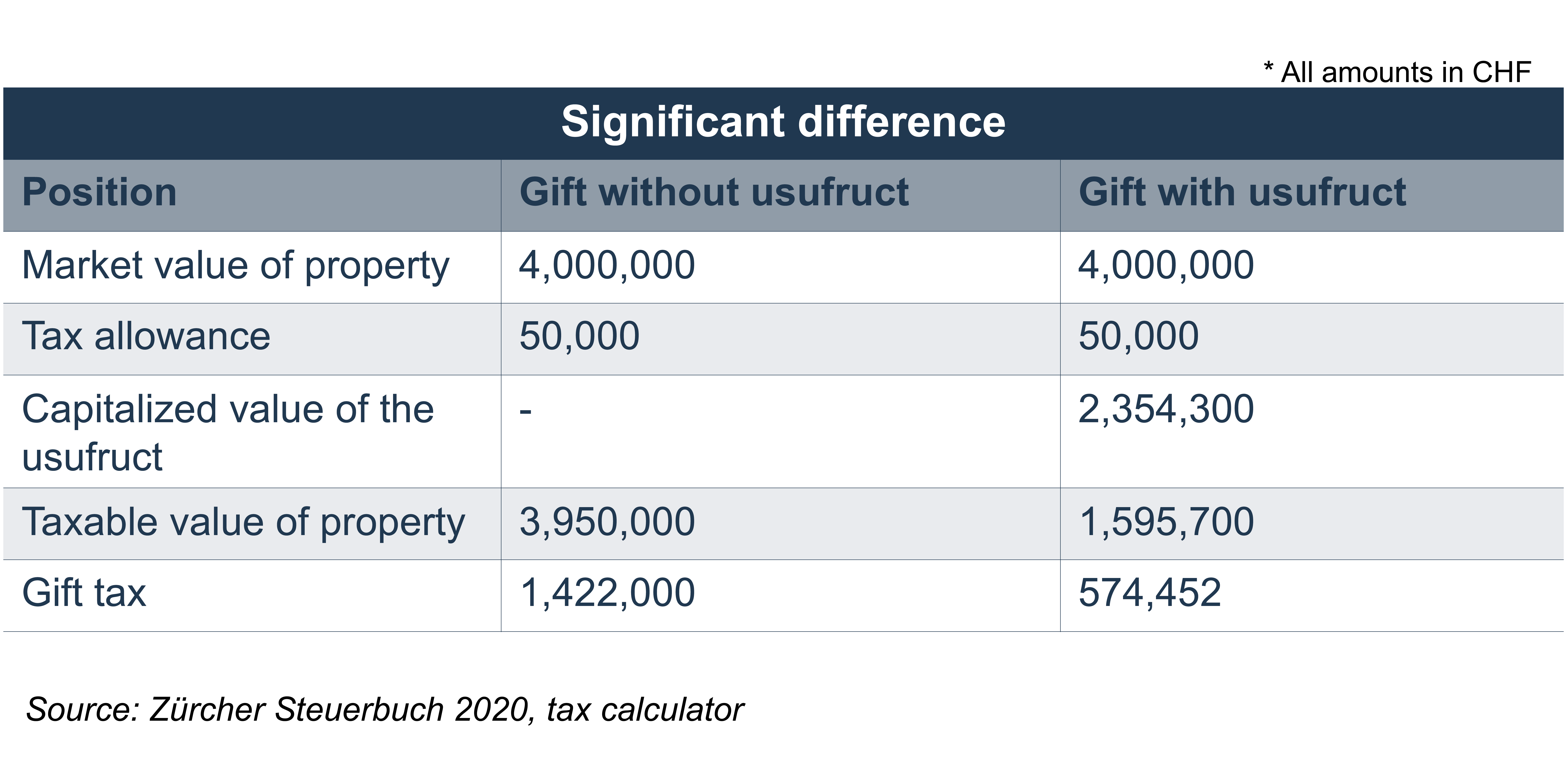
The decision to grant a usufruct on property makes a considerable difference from a tax point of view. The following example shows how significant the tax savings can be in the case of a lifetime gift with a usufruct.
Let us continue with the example of real estate. A property in the canton of Zurich has a market value of 4 million Swiss francs, and the annual market rent is 130,000 Swiss francs. The current owner is 60 years old. He is to transfer this property during his lifetime to his partner, who has been living with him in the same household for more than five years. The duration of cohabitation (Art. 21 lit. e ESchG) is relevant to the tax allowance (deductible or not).
The gift of the property will be subject to a usufruct of the annual market rent. This will be granted to the current owner when the gift is made to his partner (after which the owner becomes the «usufructuary» and his partner becomes the property owner). The capitalization factor for a 60-year-old usufructuary is 18.11 (Zürcher Steuerbuch Nr. 502.1, August 2020), with a capitalization interest rate of 3 percent – which gives a capitalized value of the usufruct of 2,354,300 Swiss francs. According to the tax calculator, the gift tax (state and municipal taxes) amounts to 1,422,000 Swiss francs. It should be noted that only the amount stated on the tax invoice is decisive for the actual tax payment. Online calculations are considered provisional.
Usufruct does not trigger real estate gains tax
For the calculation of gift tax, the usufruct is valued using the capitalized amount. In the case of a usufruct over real property, a) a public deed and b) an entry in the land register is required. The granting of a usufruct does not trigger real estate gains tax (GGSt).
In Switzerland, the federal government does not levy inheritance or gift tax. However, inheritance and gift tax are levied at cantonal level by all cantons except Schwyz. The approach for calculating inheritance and gift tax is otherwise identical in all cantons.
Early planning, external expertise
Regardless of this, the younger the usufructuary, the higher the capitalized value of the usufruct. The higher the capitalized value of the usufruct, the bigger the tax savings. This is illustrated in the example given above (see table): the capitalized value of the usufruct and the tax allowance are deducted from the market value of the gift. Using canton Zurich as an example, the gift tax allowance is CHF 50,000 (to cohabiting partners), CHF 15,000 (to siblings) and CHF 200,000 (to parents), and this gives the taxable value. This value is decisive for the calculation of the gift tax payable.
In conclusion, it is worth dealing with estate planning at an early stage. A gift during one's lifetime with a usufruct is an opportunity to plan one’s estate in accordance with one's own wishes. The advantages of this vary depending on the type of asset donated, and the relationship between the donor and recipient of the gift. Last but not least, there are also different cantonal laws. It is therefore advisable to obtain appropriate professional advice.

Do you have any inquiries? Dr. Roderik J.P. Strobl, Relationship Manager Key Clients, will provide you with the information you need.
_
This article is aimed at providing a general overview and summary of the issue. It is non-binding, and does not and should not be taken to constitute legal advice.

This article describes key changes in the new Swiss inheritance law, including some examples.

COVID-19 has had a profound impact on family businesses, especially with respect to operations, investments, digital money and the coaching of the next generation.

