

Family office trends are changing the financial and fiduciary services industry. Dr Roderik J. P. Strobl, TEP, surveys the global family office landscape.
First published in the STEP Journal, Issue 3 2024 (18 June 2024), under the title ‘Follow the trend’. Reproduced here with the kind permission of STEP. The original article is available at journal.step.org.
The purpose of family offices (FOs) is to manage, oversee and preserve the wealth management and business affairs of high-net-worth (HNW) families, as well as financial, family and philanthropic legacies. [1] The rising importance of FOs in recent years has increased the demand for services of single- and multi-FOs worldwide. FO trends are normally monitored through extensive international surveys. In this article, primary FO trends, predominantly related to 126 major FOs in North America (60 per cent), Latin America (17 per cent), Asia Pacific (12 per cent) and Africa, Europe and the Middle East (11 per cent), are discussed below.
Third-party service providers are likely to see the next generation being more involved in developing and reviewing wealth strategies, as they will be in the process of taking more control of the family’s affairs. Although generational transfer of wealth is one of the main purposes of FOs succession, around 60 per cent of surveyed succession plans have yet to be developed, especially for FOs with assets of USD100–250 million. [2] Due to increased complexity in investments (both liquid and illiquid) and the outsourcing of functions such as legal advice, third-party service providers are being used ever more frequently to provide additional security and expertise. [3]
Although key competencies are dealt within the FOs, such as strategic allocations in the area of private equity, outsourcing to third-party service providers is perceived by FOs as an improvement to the overall service quality for existing clients, in part as it frees up extra resources. Service quality is one of the key antecedents of trust formation and continuity in advisor and FO business relationships. [4] One area of significant potential growth is digital asset services, such as non-fungible tokens (NFTs), where FOs require expert advice in regulation and reporting obligations. [5] The demand for philanthropic services related to impact investing is also growing and practical expertise in targeted causes is highly sought after.
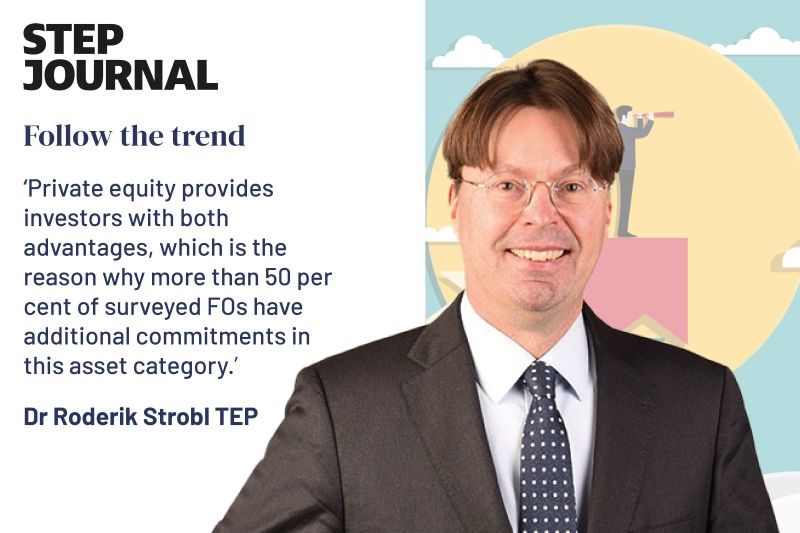
FOs are in pursuit of diversification and uncorrelated returns. Private equity provides investors with both advantages, which is the reason why more than 50 per cent of surveyed FOs have additional commitments in this asset category. This is followed by real estate investments at more than 40 per cent and public equity (such as healthcare) at more than 30 per cent in 2022, cashing out on the latter due to increased volatility compared to the previous year. [6] Direct investments remain the prime focus for around 30 per cent of the FOs. Approximately the equivalent of an FO’s direct real estate investments are spent on annual operating expenses.
The above investment strategy is a goals-based approach to asset allocation, with the goals reflecting the FO’s needs and obligations, priorities and opportunities, and desires and aspirations. Family offices are increasingly seeking direct control over investments, allowing for greater flexibility and reducing operational costs. [7]
The surveyed FOs’ top three concerns were inflation (the highest being 86 per cent for FOs in Africa, Europe and the Middle East), recession (the highest being 58 per cent in North America) and geopolitical uncertainty regarding financial assets (the highest being 79 per cent in Asia Pacific).
Portfolio values declined by more than 10 per cent in 2022 for over 40 per cent of the FOs who had made or were in the process of shifting their asset allocations. [8] Portfolio values then rebounded in 2023. As a result, strategic asset allocations in fixed-income instruments and hedge funds are increasing, [9] the latter because hedge funds provide durable diversification as they generally show little sensitivity to movements in traditional assets.
Regarding environmental, social and governance (ESG) investing, more than half of the FOs applied a more rigorous due-diligence process to ensure proper ESG impact investing. Exclusions were the most common tool and greenwashing remains an issue as there is no single standard for ESG investments. The next generation tends to advocate sustainable investing. [10] The use of artificial intelligence (AI) to enhance the operations of FOs, such as the automation of repetitive tasks, is of continued importance. AI-managed portfolios (AMPs) are on the rise, as the technology becomes more sophisticated and affordable.
Cyber and information security are often outsourced to third parties or IT providers where FOs are also shareholders. [11] Only half of the FOs have cybersecurity controls in place, which is low considering that over a third have been subject to such attacks in multiple instances. Over 70 per cent conduct vulnerability assessments and around 50 per cent have implemented cyber action plans, indicating that there is room for improvement between FOs’ goals and reality. [12]
Crypto investments are perceived as instruments in a learning process and are in high demand with US FOs. They pique the least interest with FOs in Switzerland. In this arena, FOs invest primarily in distributed ledger technology, cryptocurrencies and NFTs. Cybersecurity and safety concerns remain as obstacles.
The median number of professionals employed was one to three employees for families with assets under management of below USD250 million and four to six employees for FOs with assets between USD250 million and USD2 billion. [13] Traditionally, FOs consist of small teams that require a careful staff selection procedure that represents the largest operating cost. [14] David Poole rightfully coined the expression ‘reliable sense-makers’, which is what all advisors are in today’s time of geopolitical uncertainty and constantly changing business and regulatory environments. [15] In this context, the sorting effect of systems that rely on strong salary differentiation, such as high bonuses, tend to attract competitive individuals. [16] This approach is likely to promote a culture of decreased willingness to cooperate and a sense of distrust or decreased solidarity among other employees, which can be detrimental to the operations in a FO. [17]
Rising costs in management are triggering the need for the review and implementation of technology platforms to automate data management and reporting processes to reduce general overhead expenses.
Consequently, the optimal selection of capable ‘sense-makers’, from an FO’s perspective, remains challenging in the overall selection process. This can be counteracted by using a remuneration model that favours family wealth preservation, team versus individual rewards and trust building measures, such as increasing quality, humanity and stewardship.
Trust is at the centre of all advisor-client relationships. FOs still desire to work with advisors who are on their side of the table and represent the interests of the family. A trust strategy remains of key importance to HNW families.
Studies have shown that the quality of relationships in the business context consists of satisfaction, trust and commitment. [18] Satisfaction is achieved by building value propositions that meet customer needs and by providing a great customer experience. Trust is achieved by transparent communication and actions being consistent. Commitment is demonstrated by the advisor standing by the FO even in difficult times. A combination of a trust strategy and a superior customer decision journey promotes sustainable client relationships.
This article was written by Dr Roderik J. P. Strobl, TEP, at the time of publication with Leo Trust Switzerland in Zurich.
Do you have any questions? Contact our team, and we will provide you with the information you need.
This article is aimed at providing a general overview and summary of the issue. It is non-binding, and does not and should not be taken to constitute legal advice.

Moncucchetto 2024, co-hosted with EFG Bank, featured insightful presentations by Dr. Daniel Murray on the influence of politics on investments and Prof. Dr. Paolo Bernasconi on AI and cybercrime.

Leo Trust Switzerland AG is bronze sponsor of this year's STEP ALPINE CONFERENCE

